


Agricultural Machinery Research
In response to labor shortages and the aging population in agriculture, as well as to enhance working efficiency, production techniques, and industry competitiveness, we have researched and developed various labor-saving cultivation machinery, agricultural product processing machinery, also water and energy-saving equipment. Furthermore, to promote these applications to farmers.
Labor-saving cultivation machines
- Electric Air-blast Sprayer
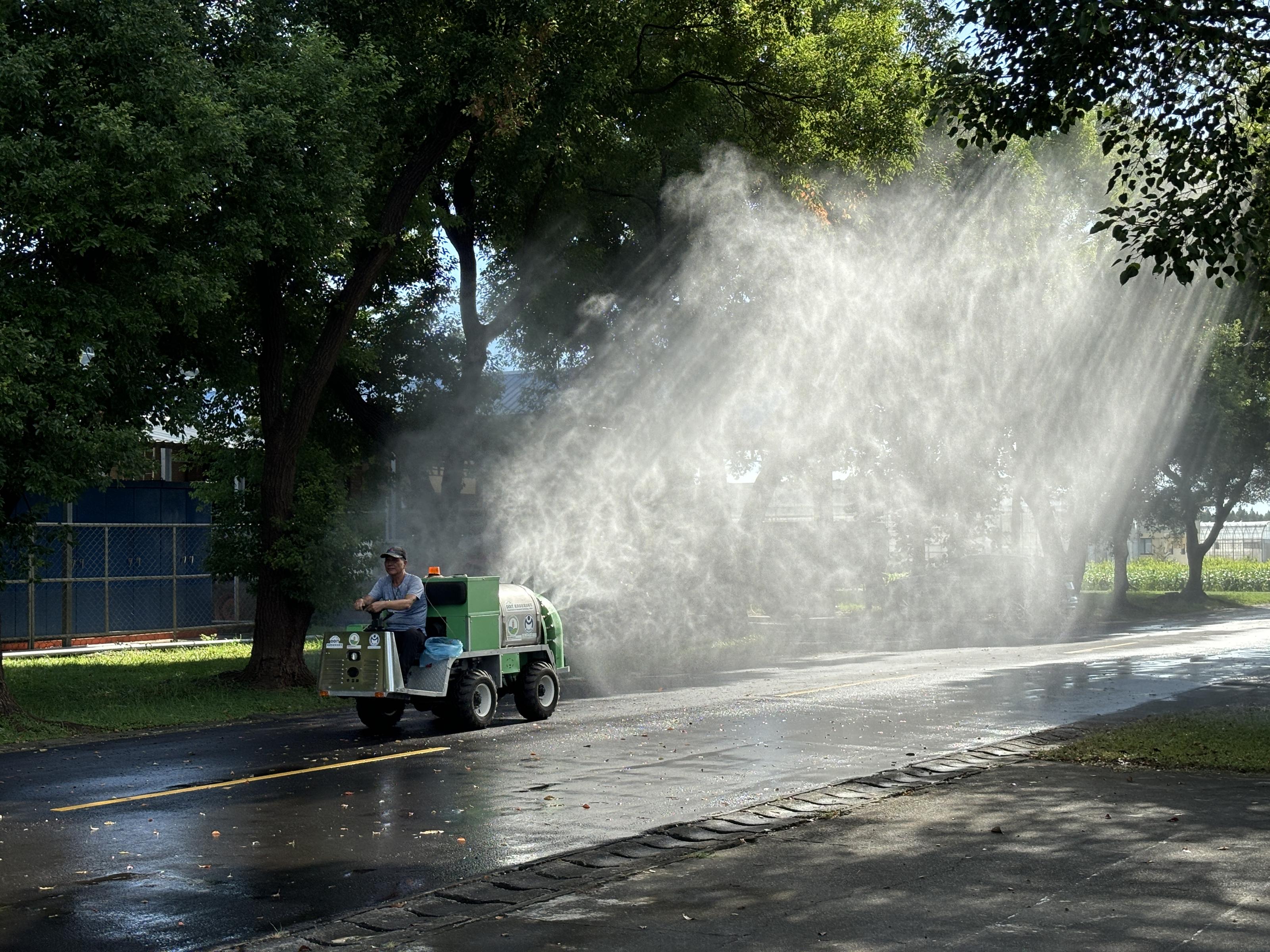
To improve the comfort of agricultural tasks and reduce carbon emissions, an " Electric Air-blast Sprayer " has been developed. Compared to traditional diesel-engine models, carbon emissions are reduced by over 80%, and noise pollution is significantly lowered, making orchard disease prevention more low-carbon, environmentally friendly, and safe. The machine is equipped with three independent electric motors that separately drive walking, air-blasting, and spraying functions. This direct power transmission improves efficiency and extends component life. During operation, the effective coverage width reaches 9 meters and the height 6 meters; high-pressure atomized droplets are pushed by the air blast to penetrate foliage gaps and adhere evenly to both sides of leaves. Featuring a 4-wheel drive and 4-wheel steering chassis, it has a turning radius of 2.3 meters, allowing it to navigate flexibly between rows of fruit trees such as grapes and sugar apples.
While traditional diesel models emit 14.9 kg CO2e per hour, the electric sprayer reduces this to below 2.8 kg CO2e. Noise levels are also reduced from over 110 decibels in diesel models to only 90 decibels. Operation is simple and intuitive, requiring only button presses or knob turns without the need for clutches or frequent gear shifting. Furthermore, maintenance is convenient, requiring only simple checks and avoiding the tedious oil changes of traditional engines. This machinery provides a new choice for orchard management that balances personnel comfort, operational efficiency, and environmental sustainability.
- Plant Potting Machine
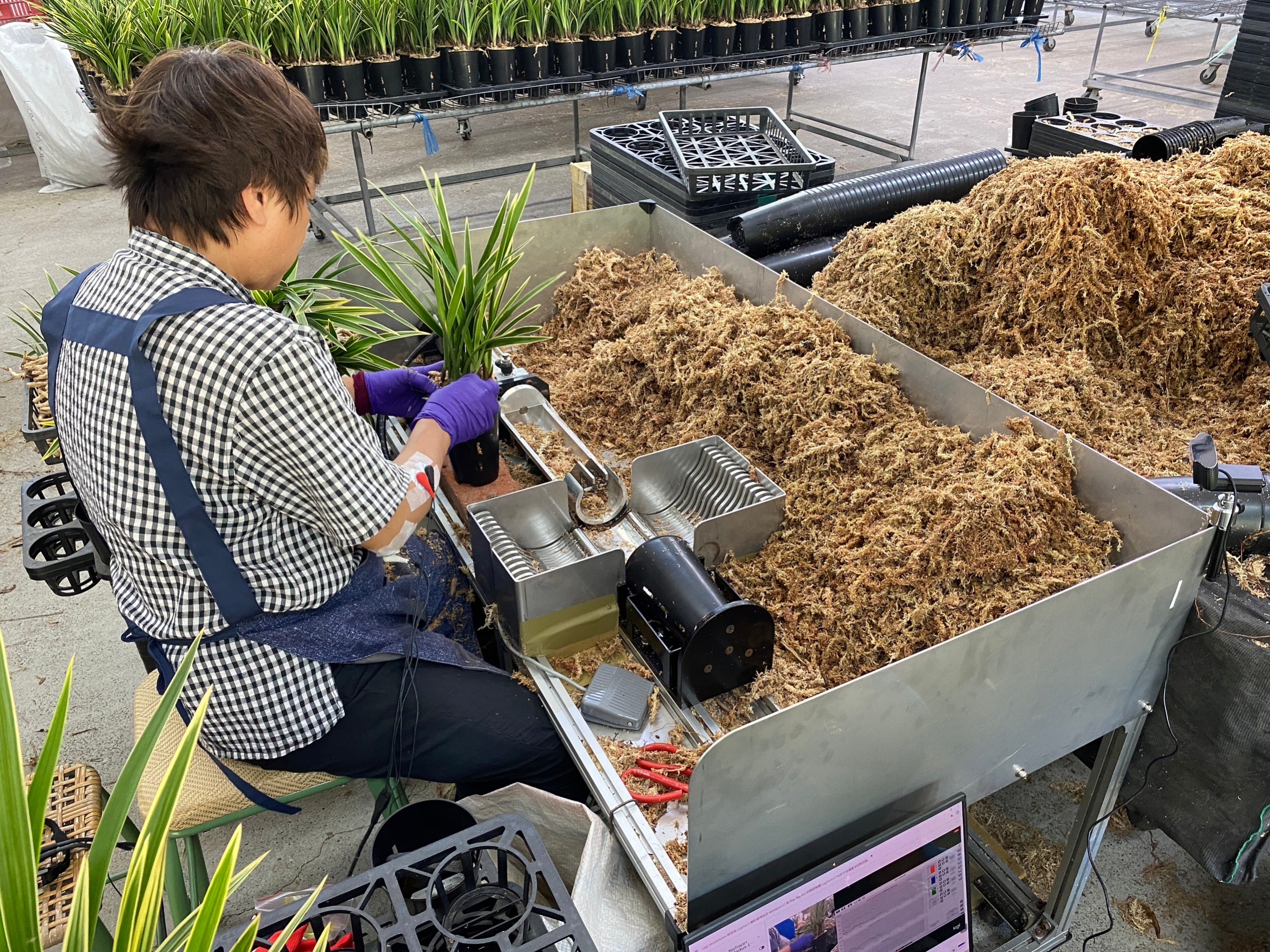
Addressing the labor-intensive and repetitive nature of potting in the floral industry, which often causes upper limb strain, this plant potting machine was developed for crops such as Phalaenopsis and Cymbidium orchids. Traditional potting requires repeated medium wrapping, seedling placement, and manual packing, which causes fatigue in the hands and forearms. This machine automates the key steps of medium wrapping, seedling pushing, and pot shaping, enhancing operational stability. Results show that mechanical assistance reduces manual muscle force by approximately 30%. The potting time for Phalaenopsis and Cymbidium is approximately 25 seconds and 53 seconds per pot, respectively, with quality comparable to manual work. This achievement holds a Taiwanese utility model patent (M624081) and completed technology licensing in 2024.
- Plant Seedling Transplanter
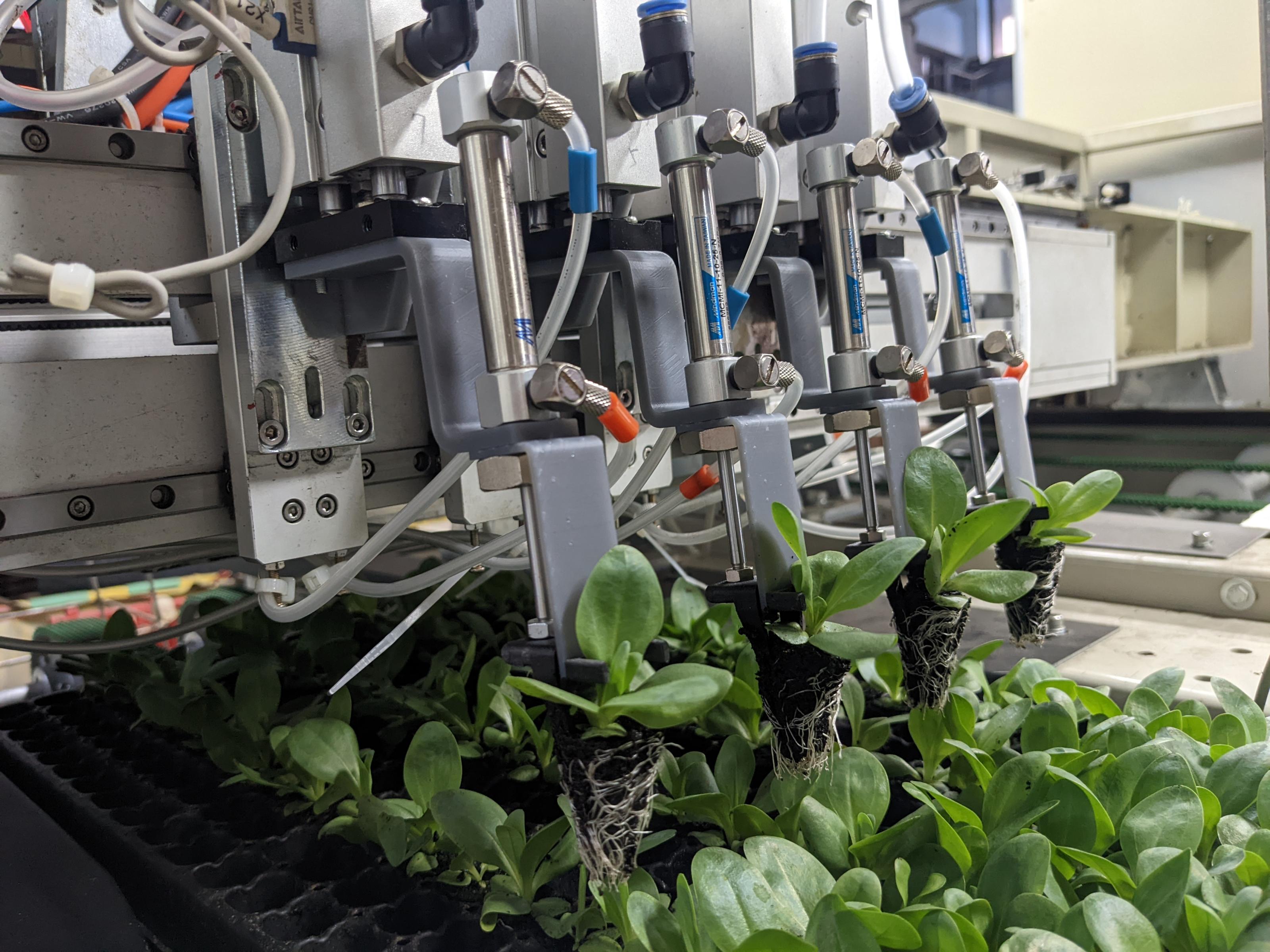
Developed to meet the high labor demand and physical burden of seedling transplanting in floral nurseries and hydroponic cultivation, this machine is specifically designed for Lisianthus (Eustoma). It automates the transfer of plug seedlings to hydroponic polystyrene cultivation trays. Traditional transplanting relies on manual labor to pick and place each seedling, which is monotonous and affects consistency. The transplanter integrates seedling lifting, gripping, conveying, spacing adjustment, and placement into seedling cups to improve efficiency and precision. Testing shows a success rate of 92% to 98%. It can complete one 40-cell tray in about 2 minutes and 21 seconds, transplanting 1,920 seedlings (48 trays) within 2 hours. This technology holds patents (M638295 and M636649) and was licensed in 2023.
- Plug Seedling Sorting Machine
This machine uses image recognition to identify missing or weak seedlings in the nursery industry, replacing the traditional reliance on manual visual inspection. The system combines modules for conveying, image capture, analysis, and pneumatic rejection. Once a tray enters the sorting area, the growth status of each cell is quickly determined, and un-germinated or poorly growing seedlings are automatically rejected. This transforms an experience-dependent process into a quantifiable and consistent management flow. For a standard 128-cell vegetable tray, the sorting time is about 30 seconds per tray—three times faster than manual work—with a success rate of 92.4%. This technology holds a patent (M659147) and completed non-exclusive licensing in 2026.

- Digital Simulation Training Platform for Agricultural Tractors
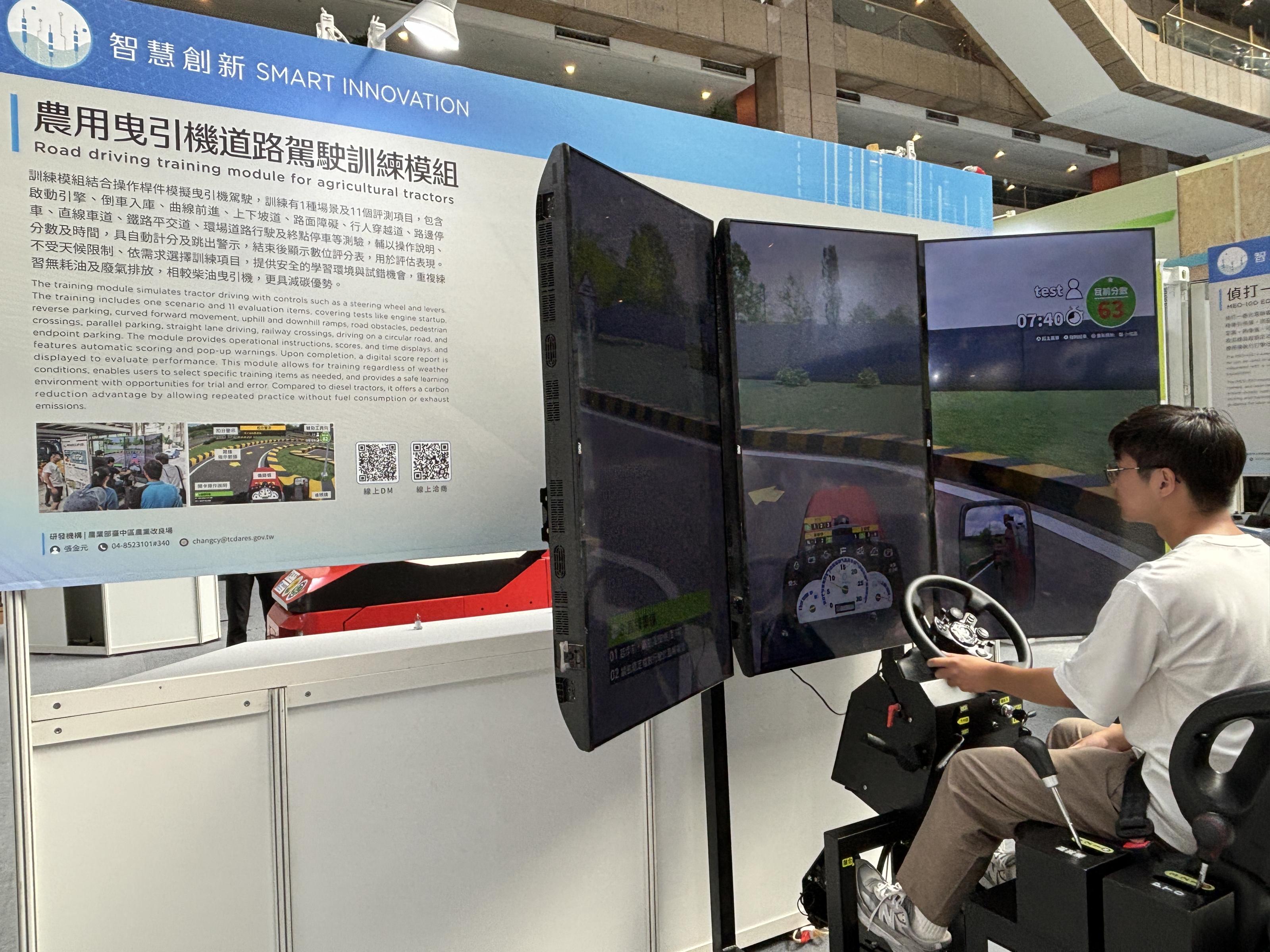
Traditional tractor operation training requires physical machinery, suitable venues, and on-site guidance, and often lacks the ability to record learning progress. This interactive digital training system provides a solution. Tractors are common agricultural machines that can be attached to various implements for land preparation, bedding, fertilization, and transport. Operation involves complex professional skills and safety judgments that present a learning curve for beginners. This platform references historical tractor driving test routes and operational scenarios to create virtual training environments. Users can repeatedly practice starting the engine, reverse parking, ramp driving, obstacle navigation, and road driving in a safe environment. The system provides tips, warnings, and digital scoring for comprehensive feedback, improving the safety and efficiency of agricultural vocational training. This technology completed non-exclusive licensing in 2024.
- Autonomous Vineyard Spraying Robot
Developed through cross-domain collaboration, this autonomous vineyard spraying robot and common agricultural operation platform have led to a modular electric test vehicle. The vehicle measures 150 cm long, 110 cm wide, and 135 cm high, featuring 4-wheel independent motor drives with in-place rotation capability. It can travel steadily at speeds of 15 to 20 cm/sec between vineyard trellises and perform modular tasks such as navigating main roads, turning, and controlling spray activation. The system integrates vehicle control with an IoT architecture to simultaneously collect operational parameters for movement, power systems, and spraying. In a field with a row spacing of 3 meters and a depth of 30 meters, it takes 20 minutes to complete operations across 4 rows. The horizontal spray coverage is 4.5 to 5 meters, with a flow rate of approximately 15.1 L/min under 3.7 MPa of pressure. This represents a significant achievement in autonomous navigation, integrated spraying, and data-driven monitoring for trellis orchards.

- Electric Fertilizer Spreaders
The electric fertilizer spreader uses centrifugal air-blowing to distribute fertilizer. It prevents bridging with a rotating agitator in the hopper. The discharge system has three switches for precise downward, left, and right distribution, with flow rate adjustment. Efficiency increases fourfold, using 440 Wh/hr. Compared to similar fossil fuel engines, it reduces carbon emissions by 71%. The front-wheel design with an electric motor allows easy movement, and the rear wheels come in single or double configurations. It suits row vegetable gardens and orchards, reducing labor, increasing efficiency, saving energy and reducing carbon emissions.
- Gravel and medium separation processing machine for orchid
The machine comprised an adjustable-speed drum with perforations and related components. People put plants into the rotating drum where the agitation detaches the gravel that will be sifted out through the drum's perforations. Meanwhile, the tilted design and spiral arrangement of cylindrical iron rods inside the drum propel the plants backward. There are two types: one is hand-push type which has four supporting wheels and is driven by an AC motor. It concentrates the sifted gravel into a conical hopper, then is transferred via an inclined conveyor belt. The other is mounted on a farm-land carrying car and driven by the car’s engine through a gearbox to make the drum rotate. Then, the separated gravel is conveyed laterally via a conveyor. With machine assisting, the efficiency is three times faster than manual operation.
- Attached two-row taro seedling transplanter
The attached two-row taro seedling transplanter which has two pairs of transplanting parts and seedling stand adopts a team of 3 workers, one drives the tractor, the other two workers supply the taro seedlings. The seedling stand can carry 2,000 taro seedlings. The transplanter starts to break soil, trenching, clamping up seedling down to the trench, and covering soil twice, then two workers sit behind the transplanter give seedlings to the clamp within 3 seconds. It can not only enhance the seedling planting efficiency up to 23.1% compared with one person but also avoid the injuries by bending over while planting. The planting distance in row can be adjusted to the range of 60-80 cm, and the space can be adjusted by changing different gears and clamp numbers with 12 combinations as well. In addition, there were not significant differences on horticultural traits, yield and harvest quality of taro between mechanical and manual transplanting. The output increased by 3.3% compared with manual production.
- Tomato seedling grafting auxiliary machine
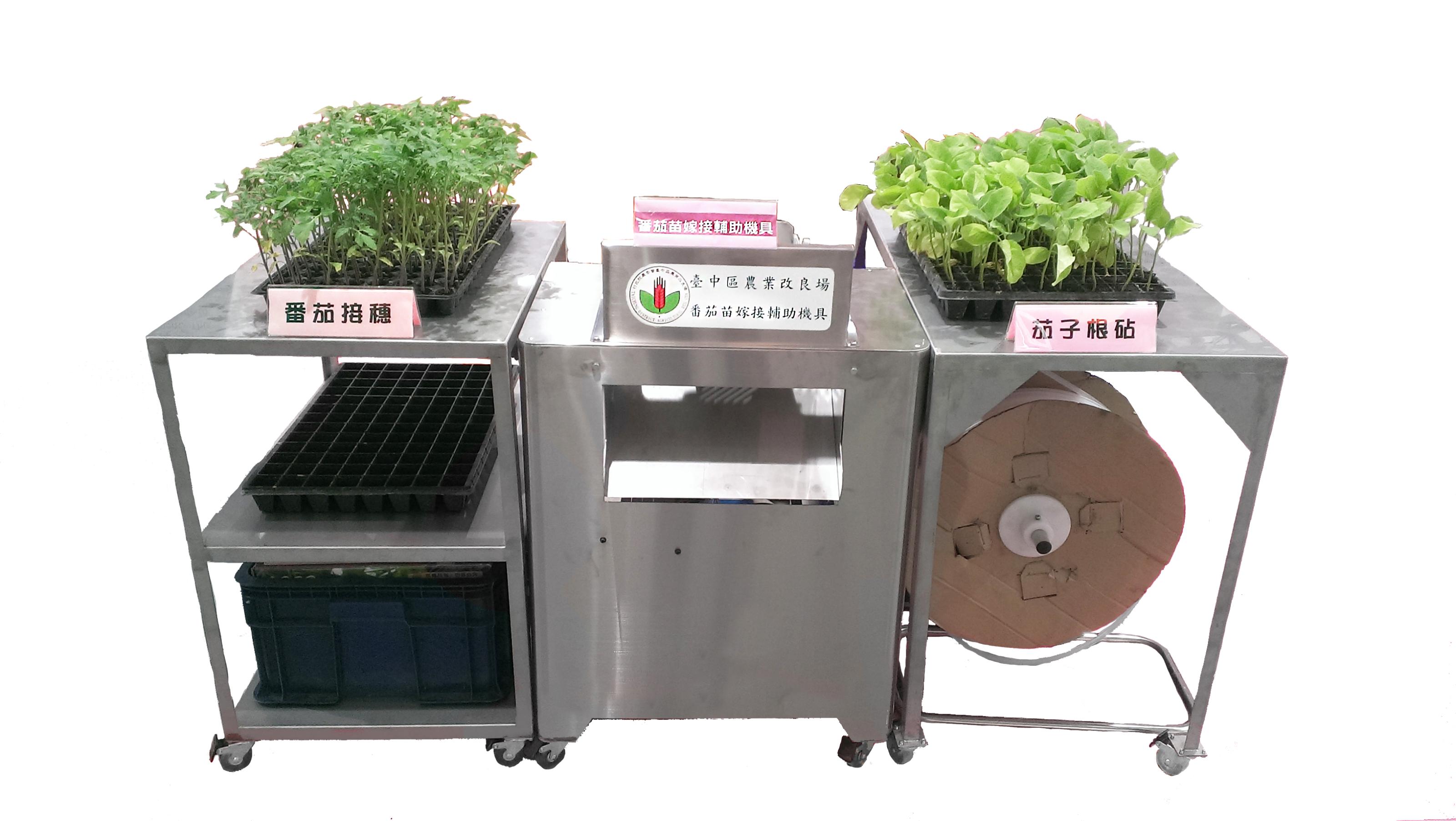
Grafting is a highly technical skill that requires professional training. During peak seasons, there was a risk of labor shortages of causing operational bottleneck. And manual grafting is labor-intensive, straining, and time-consuming. The key grafting techniques involve the scions and rootstocks slant-cutting, the graft union securing. The machine consists of mechanisms for scions and rootstocks slant-cutting, grafting clip union, also electrical control components. In comparison to manual grafting, people don’t need to take blade for cutting or handling grafting clips for fixing union. It ensures a stable slant-cut angle, then automatically supply and apply grafting clips so that unskilled operators can be trained in a short time. Compared to manual operation, it has similar success and completion rates.
- Tomato seedling grafting auxiliary machine with Conveyor
To extend the research of tomato seedling grafting auxiliary machine, a conveyor belt and sub-station workbench are added to construct the workflow which is standardization, scaling, and standardization. The grafting machine requires 4 people, and its success rate is 97%, the survival rate is 92%, and the average grafting is 3.4 plants/sec. It takes 5 minutes 53seconds to complete 1 tray grafted seedlings.
- Electric self-propelled lifting carrier
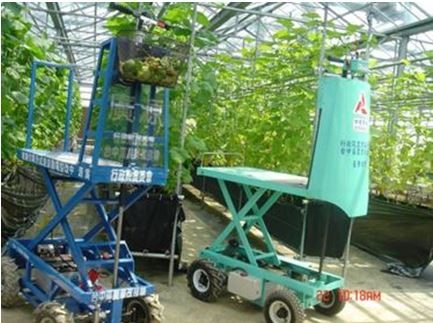
The lifting carrier driving by one DC motor for moving and one hydraulic device for lifting that powered by 2 batteries. Its lifting height is about 80c m, loading capacity is more than 200 kg. The working efficiency is 3 times faster than that of the manual. Full charged batteries can be used for 2-4 days. It is good for high-stem crop cultivation and harvesting in greenhouse. Till 2016, extension result was cumulated total about 220 units that got output value about NT$20 million.
- Ride type fertilizing machine for orchard
This fertilizing machine was 4 wheel driving and four-wheel steering, power by a single cylinder diesel engine. The sand-like fertilizer was auger-pushed to the centrifugal turntable, and drop on ground under the canopy. The spread volume, direction and angle can be adjusted. The working efficiency is 5 times faster than that of the manual that was 80% labor-saving.
- Push type fertilizing machine
The simple fertilizing device can spread organic fertilizer with granular or powdered form in labor-saving, none machine power and none exhaust gas pollution. The position and height of operation handle can be adjusted for pull or push mode. The fertilizer hopper volume was 30-35 kg, has 3 spreading volumes can be chosen. The working efficiency is 3 times faster than that of the manual.
- Tri-wheel Electric Self-propelled Sprayer
The tri-wheel electric self-propelled sprayer used DC24V batteries power to drive the rear axis. Moving speed is about 0.5-6.0 km/h, one 150 litter water tank can be sprayed about 0.1 ha in 40 minutes and 10 flat type nozzles’ spraying volume is about 3.7 l/min. It is spraying volume saving in good pest control and the operation efficiency is 3 times faster than manual.
Agro-processing machines
- Flat-box folding machine for orchid
Manual box-folding involves repetitive actions, causing potential musculoskeletal injuries to workers' shoulders, necks, fingers, and wrists. The machine is designed to aid the packaging process, including four box-folding actions using mechanical components, including folding short sides and long sides of box, inserting short and long box flaps. This is achieved with pneumatic cylinders, suction cups, a programmable controller, sheet metal, and a frame to facilitate box folding through pneumatic components.
Folding boxes takes people 6-10 seconds per box and completes about 360-600 boxes per hour which is tedious and monotonous. Conversely, it takes 9-10 seconds per box with machine assistance and people only have to place the cardboard. This significantly reduces manual effort by over 80% and is estimated to decrease upper body strain by approximately 60%. Next, we aim to develop a fully automated folding process that optimizes personnel management and reduces labor costs.
- Buckwheat centrifugal sheller
This centrifugal buckwheat hulling machine is compact in size with full function is suitable for domestic farmers to hull buckwheat seeds, and designed to reduce the broken kernels problem while doing mechanical hulling. There are two new patents awarded, one is “grain shelling and sieving machine structure”, the other is “centrifugation disc structural improvement of shell removing machine”. The broken kernel rate is reduced by 18.62% compared with the existing machine, and the shelling rate is increased by 13.43%. The machine can also separate kernels, flour and shells, also improve processing efficiency and product value.
- Multi-layer vibratory sorter for grain
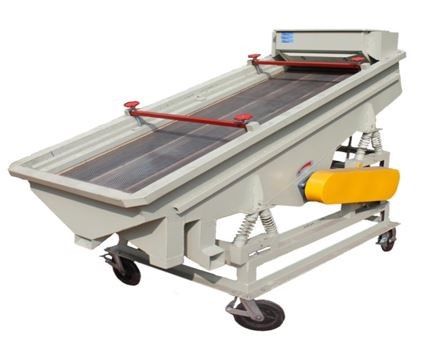
Grain sorting range depending on the grain size. The more grades of sorting, the better quality for product. This sorter has 4 screen layers can get 5 grading products. The screen layer can be changed for various of grains such as soybean, buckwheat, red quinoa, etc.
Water and energy saving machines
- Timely irrigation trigger device
The micro-climate in greenhouse was irregular changed due to seasonal wind, cloud or rain. Timing control is not applicable in Taiwanese greenhouse for energy, water and nutrient saving. The timely irrigation trigger device can run the irrigation pump which proportion with the solar radiation, that shown adequate irrigation amount of water in sunny day and automatically reduce 50-80% irrigation amount of water in cloudy or rainy day. This technology transfer was carried out in 2016 and 2017.
- The solar power system
Built the elevated 48 kWh solar power system, solar panels always face to the solar. The hoop frame plastics house was under the solar panel frames as the protected soil cultivation. This system generated 60,000 KWH power per year. It is combine agriculture cultivate with optoelectronic technology to make value addition.
 |
|
| ▲ Electric Fertilizer Spreaders | |
.jpg) |
 |
| ▲ Attached two-row taro seedling transplanter | ▲ Tomato seedling grafting machine with Conveyor |
 |
.jpg) .jpg) |
| ▲ Tomato seedling grafting machine | ▲ Buckwheat centrifugal sheller |
 |
 |
| ▲ Electric self-propelled lifting carrier | ▲ Ride type fertilizing machine for orchard |
 |
 |
| ▲ Push type fertilizing machine | ▲ Tri-wheel Electric Self-propelled Sprayer |
 |
 |
| ▲ Multi-layer vibratory sorter for grain | ▲ Timely irrigation trigger device |
 |
|
| ▲ The solar power system |